Ragdoll Gladiator Arena Weapons & Cards Guide
Known card stats, weird-weapon flavor, and how presentation maps to real effects.
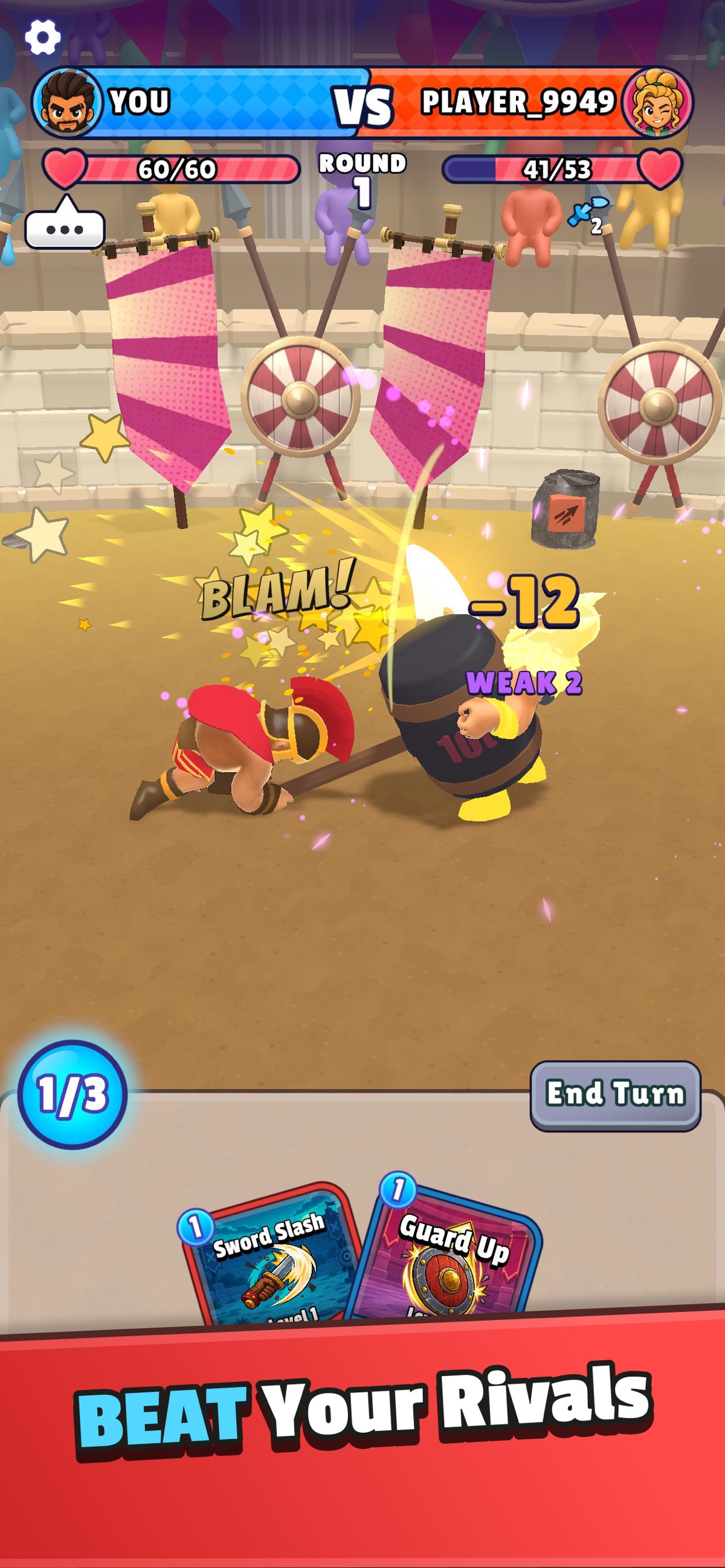
Ragdoll Gladiator Arena sells combat with ridiculous weapons — frying pans, hammers, swords — while the rules live on card text. This page catalogs confirmed early cards from official screenshots, explains the weapon fantasy, and tells you how to evaluate new cards as arenas unlock more of the collection. Exact numbers appear only for cards we can verify: Sword Slash, Guard Up, Double Chop, and Pan Slap.
For building with these tools, see Deck Building. For sequencing them in a match, see Arena Combat. Strength opinions live on Card Tiers.
Confirmed card catalog (early pool)
Sword Slash — 4 Damage
The clean sword fantasy. One action point, four Damage, no extra keywords on the base reveal. Use Sword Slash when:
- You need predictable chip through partial Block.
- You have one point left and must not brick.
- Vulnerable is already applied and you want efficient payoff.
Sword Slash is the yardstick for other damage cards. If a future card deals less than 4 without a keyword, ask what else it offers.
Guard Up — 6 Block
The defensive cornerstone. Six Block for a play is a large early-game cushion relative to Slash’s 4 Damage. Use Guard Up when:
- Hearts are low and Opponent’s Turn is incoming.
- You expect Pan Slap or Chop sequences from the opponent.
- You are banking a turn to set Vulnerable next cycle.
Control decks lean on Guard Up; Aggro decks keep a few copies as insurance. Details in Control and Aggro.
Double Chop — 2×3 Damage
Two hits of three Damage. The hammer or dual-strike fantasy fits the name. Why it matters:
- Split damage can finish awkward heart remainders.
- Partial Block may absorb one instance differently than a single six-damage swing would.
- With Vulnerable active, both instances benefit from the setup.
Double Chop rewards players who track leftover hearts precisely instead of only thinking in big round numbers.
Pan Slap — 6 Damage + 2 Vulnerable (level 1)
The signature weird weapon. A frying pan that both hurts and debuffs. At level 1 it deals 6 Damage and applies 2 Vulnerable. That dual purpose makes Pan Slap a pivot card:
- Tempo decks slap early to own the next turns.
- Aggro decks slap as reach plus setup.
- Control decks slap to punish stalled boards after Guard Up wars.
Never dismiss Pan Slap because it looks comedic. In ragdoll presentation the pan is the joke; in rules text it is a serious engine piece. Mid-fight habits for Vulnerable tracking are on the Tools Hub.
Weapon fantasy versus rules text
Official art and animations show:
- Swords for clean slashes
- Hammers / chops for multi-hit impacts
- Frying pans for slapstick finishers
- Ragdoll bodies that bounce when hit
Mapping tips:
| Presentation | Rules focus |
|---|---|
| Sword swing | Reliable single Damage (Slash) |
| Double strike / hammer energy | Multi-instance Damage (Chop) |
| Pan impact | Damage plus Vulnerable |
| Defensive stance / shield cue | Block (Guard Up) |
If a new card shows a wild weapon but short text, believe the text. The pan does not secretly deal 20 because the animation is loud.
Cards you have not seen yet
Progression and store messaging imply more cards appear as you progress through arenas and rewards. When an unknown card drops:
- Screenshot or note Damage, Block, Vulnerable, and any unique keyword.
- Compare to Slash (4), Guard Up (6 Block), Chop (2×3), Pan Slap (6 + 2 Vuln).
- Decide which three-point turn it improves.
- Cut a weaker card in the same role.
- Test on Lionstone before an Ironclaw push (Ranks).
This wiki will not invent stats for unconfirmed cards. If another site lists a full encyclopedia without sources, treat it as unverified.
Leveling and upgrades
Pan Slap’s public example is explicitly level 1. That wording implies cards can level and that numbers may rise. Until patch notes spell out a full upgrade curve, evaluate each card at the level you actually own. After updates, re-read Updates and adjust Best Decks.
Building identity around weapons
- Sword identity: efficient damage turns, low variance.
- Hammer / chop identity: messy boards, leftover hearts, Vulnerable payoffs.
- Pan identity: setup turns, mid-range fights, psychological pressure.
- Guard identity: longevity, Bronze League consistency, anti-burst.
Most strong early decks mix identities instead of pure cosplay. A pan-only joke list is fun on Lionstone’s 0/330 track and fragile on Ironclaw’s 0/1260 climb.
Collection hygiene
- Prefer playable upgrades over hoarding duplicates you do not understand.
- Keep a notes file of card text as you unlock them — handy when the meta shifts.
- Ignore “code for legendary pan” rumors; see Codes for the real status (no verified promos as of November 2026).
- Download size is sizable (~278 MB); keep storage free so updates that add card art do not fail mid-patch.
Example evaluation walkthrough
Suppose you unlock a hypothetical new card later. Ask:
- Does it beat Sword Slash’s 4 Damage raw?
- Does it beat Guard Up’s 6 Block when you need defense?
- Does it apply Vulnerable comparable to Pan Slap’s 2 at level 1?
- Can it be played meaningfully inside a three-point turn with your existing core?
If the answer is “no” to all, it is a novelty — park it until a niche matchup appears.
Related pages
- Full guide index: Guides Hub
- Beginner flow: Getting Started
- Tier opinions: Tier List Hub
- Official distribution: Official Links
Learn the four confirmed cards cold. Everything else in the collection should earn its slot by beating them at their jobs — not by looking cooler in a ragdoll replay.
Frequently Asked Questions
Quick answers to the most common questions.
Which cards have confirmed stats?
Sword Slash (4 Damage), Guard Up (6 Block), Double Chop (2×3 Damage), and Pan Slap (6 Damage + 2 Vulnerable at level 1).
Why is Pan Slap important?
It combines solid Damage with Vulnerable application, so it both chips hearts and sets up later turns despite the joke frying-pan fantasy.
Do hammers and pans have hidden damage?
No. Weapon visuals are presentation. Trust the card text and the heart/Block UI for results.
Will I get more cards later?
Yes. More cards appear as you progress through arenas and rewards. Log their text when unlocked instead of relying on unverified external lists.
Does card level change numbers?
Pan Slap is shown at level 1, which implies leveling exists. Always play according to the stats on your owned copy after upgrades or patches.
Where should I read about deck ratios?
Use the Deck Building guide and Best Decks page for Aggro, Control, and Vuln-pan archetypes built from these cards.